If you want to know where monetary policy is going, stop reading the press conferences and start reading the personnel announcements.
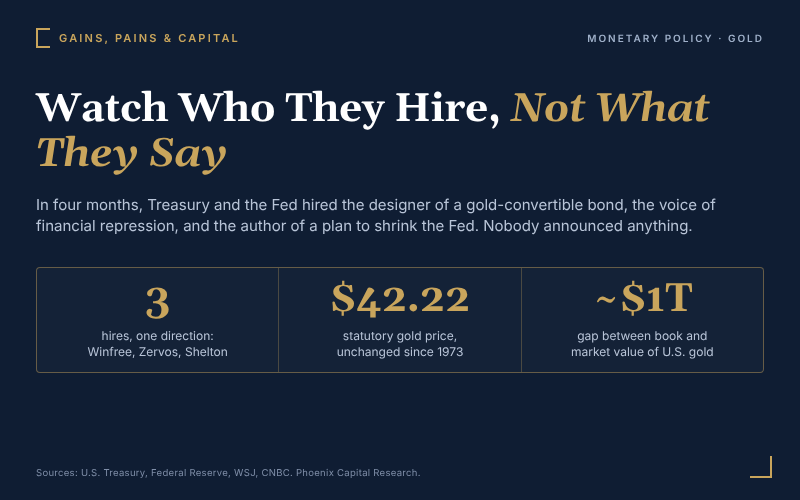
Over the past four months, the Treasury Department and the Federal Reserve have quietly hired three people whose published work points in the same direction. None of the hires made the front page. Together they tell you more about the next five years of American money than anything Warsh or Bessent has said into a microphone.
Start at the Fed. On June 2, less than a month after taking the chair, Kevin Warsh brought in Paul Winfree as an adviser for “policy analysis and planning.” Winfree ran budget policy in the first Trump White House and, in 2023, wrote the Federal Reserve chapter of the Heritage Foundation’s Mandate for Leadership. That chapter calls for winding the Fed’s balance sheet down “as quickly as is prudent” toward pre-2008 levels, ending interest on excess reserves, restricting the Fed to buying only Treasuries, and appointing a commission to re-examine the Fed’s mission. It also names “gold-convertible Treasury instruments” as one path toward backing the dollar with something harder than promises. Five weeks after Winfree arrived, the Fed announced a task force to review “the costs, benefits, and institutional implications” of its balance sheet regime. That review is exactly what his chapter asked for.
Now Treasury. On September 28, Scott Bessent made David Zervos a Counselor to the Secretary. Zervos spent years as Jefferies’ chief market strategist and was on Bessent’s own short list for Fed chair last year. His public record is on one subject above all others: financial repression, the practice of holding the return on safe savings below inflation so that inflation does the work of shrinking the government’s debt. He has been describing that playbook, and its consequences for savers, for over a decade.
Eleven days later, on October 9, Bessent gave the same title to Judy Shelton. Her official brief is currency policy “with a particular focus on evaluating financial conditions in China.” Shelton has spent fourteen years designing a U.S. Treasury bond redeemable in gold at maturity, and she has argued in print that the government should revalue its gold reserves from the statutory $42.22 an ounce to the market price and pledge the proceeds behind that bond. In her own framework, the gold bond and the China assignment are the same job. A bond convertible into gold fixes a reference point for the dollar, and any trading partner holding its currency below that reference shows up against it. The Senate blocked her nomination to the Fed board in 2020. Counselor to the Secretary requires no Senate vote.
So here is the lineup. The Fed chair’s office now contains the man who wrote the plan to shrink the Fed and open the door to gold-linked debt. The Treasury Secretary’s office now contains the woman who designed the gold-linked bond and the strategist who wrote the book on keeping savers’ returns below inflation. And Warsh, before he took the job, said publicly that the country needs “a new Treasury-Fed accord, like we did in 1951,” so that the Fed chair and the Treasury Secretary can tell markets together “this is our objective for the size of the Fed’s balance sheet.” The Fed’s own calendars show him meeting Bessent roughly three times a month since June, mostly at breakfast.

I want to be precise about what this does and does not mean.
It does not mean a gold revaluation has been decided. There is no bill, no rule change, and no movement in the account where this would show up first: the Fed’s gold certificate account, which has sat at $11.037 billion for decades and was unchanged as of the last weekly statement. Bessent himself waved off revaluation talk in February 2025. Hiring the authors of a plan is not the same as executing it.
Still, for those who push back on this reading, I’d ask a simple question: what is the alternative explanation? That the Fed chair hired the author of a plan to shrink the Fed, and the Treasury Secretary hired the designer of a gold bond and the leading voice on financial repression, all within four months, and none of them intend to work on any of it? Maybe they all belong to the same mahjong club and figured it would be easier to cut straight to the games if they shared an office. I’m open to other theories. I just haven’t heard one.
There is a deeper point here about how policy of this kind actually gets made. The people waiting for an announcement misunderstand the process. Nobody at Treasury is going to walk to a podium and say, “Good news, everyone, we’re revaluing the gold.” That is how it works in the minds of armchair analysts. It is never how it works in practice, and it is especially never how it works when the subject is money, debt, and the standing of the dollar against rivals who would love to see it stumble. Operators in that world, the ones who are actually trying to move something, do not broadcast. They put the right people in the right chairs, they commission the right reviews, they build the tools in advance, and they say as little as possible until the pieces are in place. Then the thing that looked impossible on Monday is announced as settled on Friday. If you want to know what is coming, you collect the dots while they are still scattered. By the time someone connects them for you on television, the move is over.
What it does mean is that the people now sitting closest to the two institutions that control American money all share one view: the debt is too large to be refinanced at market rates indefinitely, and the way out runs through some combination of a smaller Fed, a managed long end of the Treasury curve, returns on savings held below inflation, and a harder anchor for the dollar than the one we have now. They did not hide any of this. They published it. Then they got hired.
You can already see Treasury managing the long end by hand. Since the buyback program expanded this fall, Treasury has hit its $6 billion cap three operations in a row, with investors offering up to seven times what it would take. In mid-October it retired long bonds due in 2041 at 65 cents on the dollar. Bessent called it, on CNBC, “what I would call a Treasury twist.” I will have more on that tomorrow, because the numbers are remarkable and almost nobody has read them.
For now, the question for investors is what to do while the plan sits on paper.
First, hold gold, and hold it for the right reason. The case has little to do with next month’s price. Three people who want the dollar anchored to gold now work for the two institutions that could do it, and gold is the asset that benefits whether the plan is executed quickly, slowly, or only partly.
Second, do not sit in long-duration savings earning less than inflation. That is the one outcome every person on this list is comfortable with. If financial repression is the policy, the loser is the saver in a 30-year bond at 5% while inflation runs at 6%. The winners own hard assets and businesses that can raise prices.
Third, watch the signals, not the speeches. The gold certificate line on the Fed’s weekly balance sheet. Any amendment to Treasury’s securities rulebook. A new Treasury offering with a gold clause. Warsh’s calendar. When one of those moves, the plan has moved from paper to policy, and by then the easy money in gold will have been made.

Washington announces policy with press releases and reveals it with hires. Read the hires.
This is precisely why I put together a special report called Survive the Inflationary Storm. It outlines how inflation is going to play out over the next 12 months, which assets will come out ahead, and specific investments to own as policy shifts toward hard assets and away from savers.
It normally sells for $499. I’m releasing 100 copies free to Gains, Pains & Capital readers today, and when they’re claimed the offer closes.
To pick up your copy, Click Here Now!
Best Regards,
Graham Summers, MBA
Chief Market Strategist
Phoenix Capital Research
