Every headline out of Quantico yesterday was about Elon Musk.
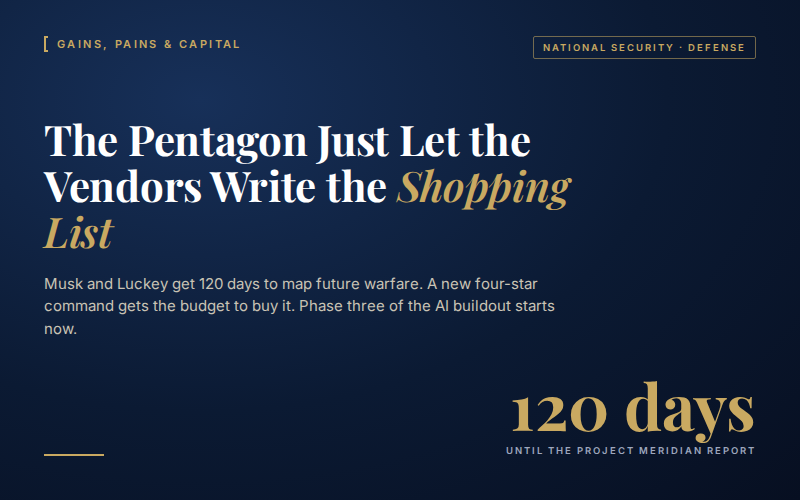
Secretary Hegseth used his State of the Force address to announce that Musk, Anduril founder Palmer Luckey, and Newt Gingrich will co-lead something called Project Meridian, a 120-day study of the future of warfare. The press ran with the celebrity angle. The financial networks barely covered it at all.
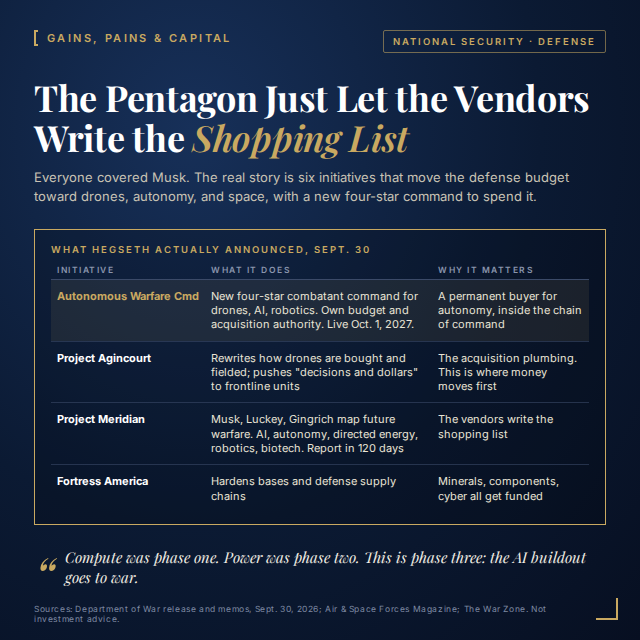
That’s a mistake, because Meridian was one of six initiatives announced in that speech, and the Musk headline is the least important of them.
Here’s what Hegseth actually did.
He ordered the creation of an Autonomous Warfare Command, a new four-star combatant command for drones, robotics, and AI, with what the memo calls “directed manpower, budget, acquisition authorities” and its own career tracks for officers and enlisted personnel. Target date: October 1, 2027. He called it “the fastest peacetime shift in modern military history.”
He launched Project Agincourt as the bridge to that command. Agincourt rewrites how the military buys and fields drones, pairing operators with entrepreneurs and, in Hegseth’s words, “distributing decisions and dollars closer to frontline units.” It builds on the Drone Dominance program that has already shipped thousands of robotic systems to the Middle East for the Iran campaign.
He announced Fortress America, a program to harden bases and defense supply chains. Read that alongside the Pentagon personnel breach we covered on Tuesday.
And then he handed Project Meridian to Musk and Luckey. The memo tells them to map the trajectory of future warfare across AI, autonomy, directed energy, robotics, and biotechnology, identify the capability gaps, and propose what to build. The scope runs “from subterranean depths to the cislunar frontier.” The Joint Staff and every service branch have been told to connect their own research to it. The report is due in 120 days, with a public rollout and a classified annex.
Think about who those two men are.
Musk owns the company that launches most of what the Pentagon puts in orbit and the satellite network the military increasingly runs on. Luckey owns the company building the drones, the autonomous systems, and the software that ties them together. The Department of War just asked the two largest vendors of future-warfare hardware to write the report on what future-warfare hardware the Department needs.
I’m not saying that as a criticism. I’m saying it as an investor, because it tells you exactly where the money is going.
This is phase three of the AI buildout.
Phase one was compute. The hyperscalers spent hundreds of billions on chips and data centers, and the market priced it.
Phase two was power. We wrote about it yesterday: 456 reactors on public land in Utah, the Air Force flying the hardware, a licensing regime rewritten so the AI race doesn’t run out of electricity. The market is starting to price that.
Phase three is application, and the first customer is the military.
All of that compute and all of that power has to do something, and what Hegseth announced yesterday is that the something is autonomous warfare. Drones that fly themselves. Satellites that target. Robots on the ground. Directed energy. A four-star command with its own checkbook to buy all of it, and the two biggest suppliers mapping the requirements. The market hasn’t priced this at all.
Put simply, the AI buildout just acquired a buyer with a $1.5 trillion annual budget, a war to fight, and an explicit instruction to move faster than it has in modern history.

The timing matters too. Meridian’s 120 days puts the report in the last week of January. That lands right behind three dates we’ve been tracking: the November 3 midterms, after which Trump has said he’ll revisit striking Iran; the December 11 funding cliff, where the war supplemental has to pass; and the January 10 expiry of the rare earth truce with China. Four hard dates in four months, and every one of them resolves toward more state-directed spending, not less.
That’s the wartime economy. The government decides what must happen, clears the obstacles, and pays whatever it costs. The bond market knows it, which is why the 10-year is above 5% while the Fed hikes. Gold knows it. And now the defense budget is being pointed at the exact technologies the AI buildout produces.
So what does this mean for you?
The biggest direct beneficiaries are private. SpaceX and Anduril are not on an exchange, and that pushes the public opportunity to three places.
First, the companies already inside the Pentagon’s systems, the data and software layer that every autonomous system has to run on. When a new command stands up and needs to see across the joint force, it calls the firms that are already there.
Second, the public drone and autonomy names with real contracts. Agincourt explicitly favors lower-cost, mass-produced, American-made systems, and there is a short list of listed companies that fit that description.
Third, the supply chain underneath it: the launch and satellite component makers, the sensor and chip suppliers, and the critical minerals that every drone, satellite, and directed-energy system is built from. Fortress America is a funding program for exactly that layer.
Everyone else is debating whether Elon Musk should be advising the Pentagon. The investors who understand what was actually announced yesterday are figuring out which companies will be selling into it.
And here’s the part that ties it all together. A four-star command with its own budget, a $1.5 trillion defense request, an $80 billion war supplemental, 456 reactors on public land, a rare earth stockpile, and now a mandate to field autonomous weapons at the fastest pace in modern history. None of that gets paid for with tax revenue. It gets paid for with borrowing, and the bond market is already charging 5% for the privilege.
That’s the environment my Special Investment Report Survive the Inflationary Storm was written for. It explains why a government in a spending race can’t let inflation go back to 2%, what that does to the dollar and to bonds over the next several years, and the five specific investments I want you holding while it plays out, including one tied directly to the buildout Hegseth just ordered.
It normally sells for $499. I’m making 100 copies available at no cost to Gains, Pains & Capital readers today, and once they’re claimed the offer closes.
To pick up your copy, CLICK HERE!
Best Regards,
Graham Summers, MBA
Chief Market Strategist
Phoenix Capital Research
