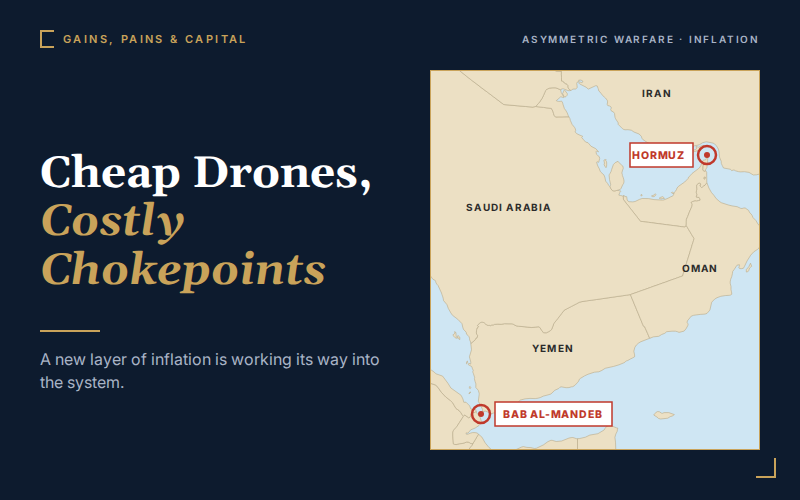
Many of Ukraine’s long-range drones cost between $20,000 and $100,000, according to public estimates.
When one gets through, it can knock out refinery equipment that takes months to replace.
That cost math is the most important economic development of 2026 that few investors are pricing correctly.
Cheap drones, and the missiles and small boats that travel with them, have handed small and mid-sized combatants the ability to impose enormous costs on the world’s energy system. Ukraine is using them against Russia’s refineries. Iran is using them against tankers in the Strait of Hormuz. The Houthis are using them around the Red Sea.
Each campaign has its own politics. Economically, they all do the same thing: they add a new layer of cost to every barrel of fuel and every container that moves through a contested route. That cost is now working its way into inflation, and it is likely to stay there.
The first layer is the refinery.
The International Energy Agency (IEA) estimates a Russian refinery was hit on average once every three days during the first eight months of 2026. Ukrainian forces now send multiple waves of drones at a single site to overwhelm air defenses, and they are now hitting secondary processing units, which the IEA estimates may take six to eight months to replace.
The results show up in the numbers. The IEA expects Russian refineries to process about 4 million barrels per day for the rest of 2026 and all of 2027, roughly 30% below pre-invasion levels. Russia has barred diesel producers from exporting since July 8, a ban it just extended through October 31.
On Monday, President Trump made the connection himself. He said record barrels are now moving out of the Gulf and blamed rising gasoline prices on refineries, specifically Russia’s, which Ukraine keeps blowing up.
The campaign is unlikely to slow. Last month Trump urged Kyiv to ease off Russian oil installations because of the effect on diesel prices. Over the weekend, Zelensky said Ukraine would instead double down on refinery strikes in response to Russia’s escalating attacks on Ukrainian cities.
This is why diesel is the fuel to watch. Combined diesel exports from Russia and the Gulf in August were 1.6 million barrels per day below February levels, when the two accounted for almost 45% of global seaborne diesel trade. U.S. diesel has since topped $6 a gallon at the pump, an all-time high.
The second layer is the chokepoint.
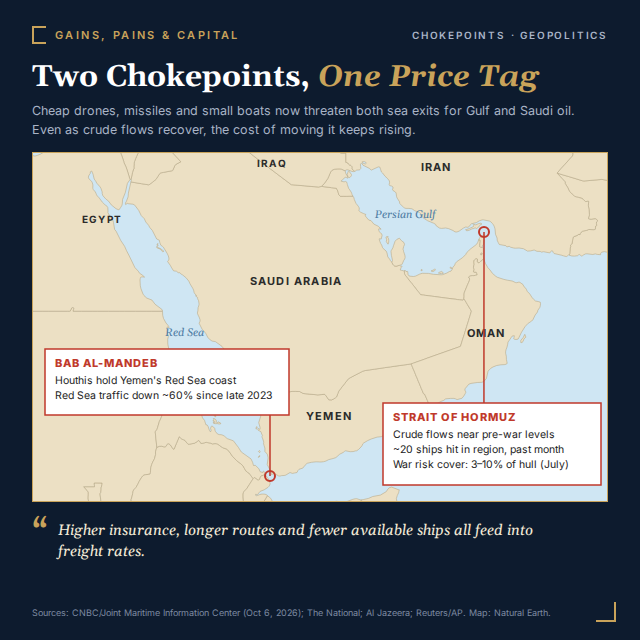
Crude flows through the Strait of Hormuz have recovered to near pre-war levels. But that recovery rests on a major U.S. military commitment, and Iran has stepped up its attacks as volumes climb. Nearly 20 commercial ships, mostly tankers, came under attack in the Strait, the Persian Gulf or off the coast of Oman over the past month, according to the Joint Maritime Information Center.
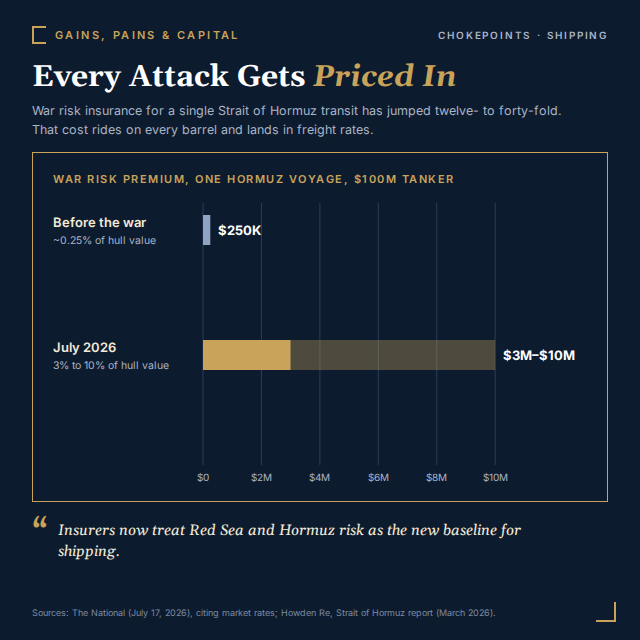
Every one of those attacks gets priced. Before the war, war risk insurance for a Hormuz transit ran about 0.25% of a ship’s hull value. By July it had jumped to between 3% and 10%, according to market rates reported by The National. For a $100 million tanker, that means a premium of $3 million to $10 million per voyage, up from roughly $250,000.
The Red Sea route tells the same story. The Houthis now control Yemen’s entire Red Sea coastline and effectively the Bab al-Mandeb strait. Red Sea traffic is running about 60% below levels before the late-2023 attacks, and ships that go around the Cape of Good Hope add roughly 10 days to an Asia-Europe voyage, according to ING.
Insurers are treating this as permanent. Reinsurance broker Howden Re described the Red Sea crisis of 2024 and 2025 followed by Hormuz in 2026 as a new baseline for marine war risk, calling it a permanent structural repricing.
Higher insurance, longer routes and fewer available ships all feed into freight rates. Freight rates feed into the price of nearly everything that crosses an ocean.
The third layer is the cost of defense, and this is where the asymmetry really bites.
A Shahed-type drone costs tens of thousands of dollars. A Patriot interceptor costs several million. Even Russia’s cheaper Pantsir missile runs about $300,000. Fire one at a $50,000 drone and Moscow spends six dollars for every dollar Ukraine spent, and the drones that get through can still take a refinery offline for months.
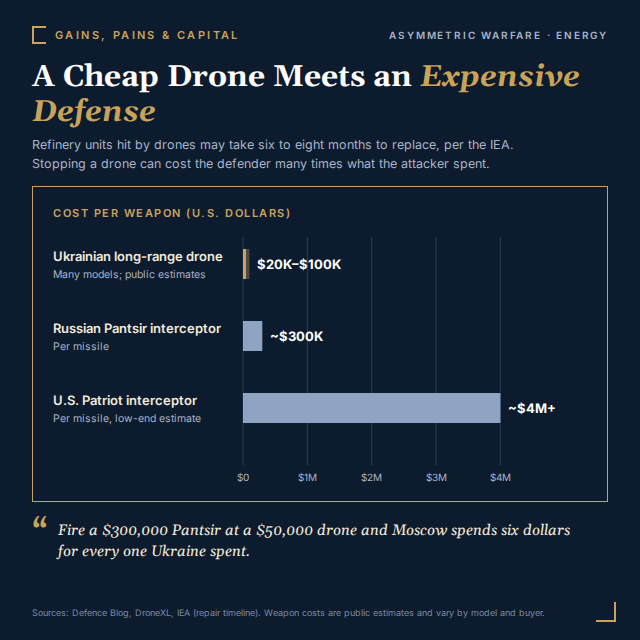
No country can afford to defend every refinery, pipeline, terminal and tanker with million-dollar missiles. So defenders do the next best thing: they spend heavily on escorts, interceptors and patrols, and they accept that some attacks will succeed.
The United States is carrying a large share of that bill. Hormuz flows depend on U.S. naval protection, and Washington is reportedly sending a third aircraft carrier strike group to the region. That spending lands on a federal budget that is already running large deficits.
In other words, the asymmetry shows up twice: once in the price of energy, and again in government borrowing.
This new layer of cost is already showing up in the inflation data, starting at the wholesale level.
In August, the Producer Price Index (PPI) rose 0.4% for the month and 5.4% from a year earlier. Diesel prices jumped 24.1% in that single month and accounted for more than a third of the increase in goods prices, according to the Bureau of Labor Statistics. Transportation and warehousing services rose 2.3%, and truck freight rose 2.0%.
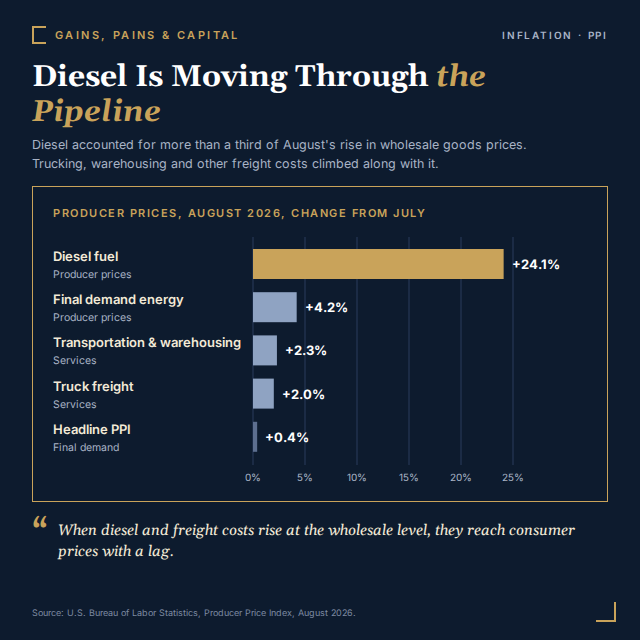
That is the pipeline. Diesel powers the trucks, trains, ships, tractors and construction equipment that every business relies on. When diesel and freight costs rise at the wholesale level, they reach consumer prices with a lag.
Consumer prices are starting to reflect it. The Consumer Price Index (CPI) rose 0.4% in August and 3.4% from a year earlier, with energy prices up 16.3%. September CPI comes out on October 14.
The bond market is uneasy as well. The 10-Year Treasury yield broke above 5% in mid-September and reached roughly 5.2% later in the month, its highest level since 2007. Heavy government borrowing is a big part of that move, and a fuel-driven inflation shock adds to the pressure.
Governments are trying to offset the damage. Last week the G7 agreed to release up to 100 million barrels of crude and diesel from emergency stocks over four months, and the IEA is meeting today to work out the details. That should help near term. But spread over four months, it works out to less than a million barrels per day, crude included, against a diesel export shortfall from Russia and the Gulf that the IEA put at 1.6 million barrels per day in August.
More importantly, emergency stocks address the symptom. The cause is that cheap weapons can now hold expensive energy infrastructure and shipping lanes at risk, and that capability is spreading. Damaged refinery units take months to rebuild. U.S. distillate inventories were about 13% below their five-year average in late September. And insurers have already reset their baseline for war risk at sea.
Even a ceasefire would leave much of this in place. The lesson every shipper, insurer and energy buyer has learned in 2026 is that a single chokepoint or a single refinery can be taken offline by a weapon that often costs less than a luxury car. That knowledge gets built into prices, contracts and inventories for years.
For investors, this means treating asymmetric warfare as a durable new input to inflation, alongside deficits and money printing. Assets that benefit from higher real-world prices for energy and commodities should hold up well. Long-duration bonds and companies with thin margins and long supply chains face a tougher road.
That is a signal to heed and invest around. To help you do that, I recently put together a special report titled Survive the Inflationary Storm. It details the investments I believe are best positioned to profit as inflation takes hold, including several with the potential to be huge winners.
It normally sells for $499. I’m releasing 100 copies free to Gains, Pains & Capital readers today, and when they’re claimed the offer closes.
To pick up your copy, Click Here Now!
Best Regards
Graham Summers
Chief Market Strategist
Phoenix Capital Research
