Stocks are bouncing this morning because things do not appear to have worsened geopolitically over the weekend. The lack of escalation in the War with Iran combined with the fact that stocks are oversold has induced traders to play for a bounce.
However, in the big picture, the situation in Iran will not be resolved quickly or easily.
The media and social media are rife with analysts who act as though this conflict can be broken down into simple narratives or soundbites… but the reality is extraordinarily complicated.
From a geopolitical perspective:
- Iran is bordered by seven nations on land (Iraq, Turkey, Azerbaijan, Armenia, Turkmenistan, Afghanistan, and Pakistan) and five nations by water (Bahrain, Kuwait, Oman, Qatar and Saudi Arabia).
- Iran is 90% Shia, the segment of Islam that has been in perpetual conflict with Sunni Islam since the mid-600s AD. Iran’s neighbor and the other dominant Middle Eastern power, Saudi Arabia, is Sunni.
- Iran has strong economic ties to China (the latter purchases 90% of Iran’s oil exports) and strong military ties to Russia (Iran supplies drones and missile technology to Russia).
- Iran borders the Strait of Hormuz, a narrow (~30 mile wide) shipping lane through which 20% of global oil and liquified natural gas is shipped.
- Iran is extraordinarily wealthy in terms of natural resources, possessing the fourth largest oil reserves in the world, 2nd largest natural gas reserves in the world, the largest zinc and lead reserves in the world, etc.
In terms of domestic issues:
- Iran is ethnically diverse. Roughly 50% of the country is Persian, but the other half is comprised of 13 other ethnicities/ tribes.
- Since 1979, Iran has been controlled by a Osulgarayan, (roughly translated as Principalists): hardline religious leaders. They control the Islamic Revolutionary Guard Corps (IRGC), the judiciary, the Guardian Council, and most state institutions. Many of these leaders have been killed during this conflict, but the Principalists remain in control of the country’s miliary/ economic resources at the time of this writing.
- Iran is a young country in terms of demographics: Roughly 50% of its population of 98 million are under the age of 30. These individuals grew up with the internet and other resources that allowed them to see the world through a more secular/ western perspective. They are frustrated by the current regime/ political structure and in favor of political reform. There have been widespread protests, but at the time of this writing, reformers have yet to seize power.
Again, the situation in Iran is extremely complicated involving a range of ethnic, religious, political, economic and geopolitical issues. No one has any idea how this situation will resolve. But what is clear is that it has the potential to ignite another wave of inflation.
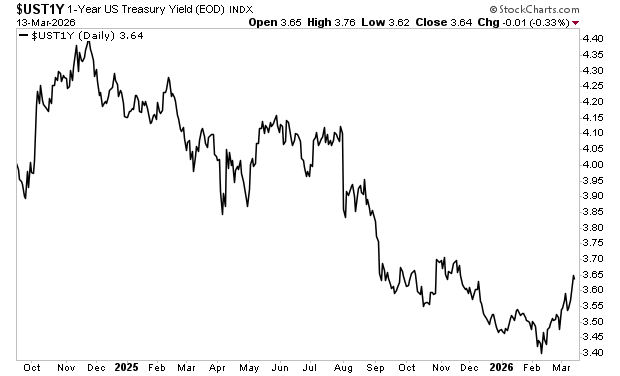
Case in point, the yield on the 1-Year U.S. Treasury, which moves in anticipation of inflationary expectations (among other things) is rising not falling. Since early February the yield on this bond has risen from a low of 3.35% to its current level of 3.6%. This suggests the bond market has removed ANY expectation of additional Fed rate cuts over the next 12 months (the Fed Funds rate is currently 3.5%).
Investors have a short window of time to prepare for what’s coming. The smart money is already rotating into hard assets and precious metals — the sectors that have historically thrived during inflationary storms.
If you’re looking for guidance on how to profit from this, I can show you how.
On that note, our Special Investment Report titled Survive the Inflationary Storm details FIVE precious metals mining plays you can use to potentially make extraordinary gains. These are HIGH OCTANE positions that rose 75%, 140%, 150%, 180%, 280% and an incredible 574% in 2025! And I wouldn’t be surprised to see them repeat this performance in 2026.
Normally I’d charge $499 for this report as a standalone item, but in light of what is unfolding today, we are making just 100 copies available to the public.
To grab one of the last remaining copies…
Best Regards
Graham Summers
Chief Market Strategist
Phoenix Capital Research
