We’ve spent the last few weeks in this newsletter walking through the Trump administration’s critical minerals push. Presidential attendance at the mining roundtable. Billions in Department of War (DoW) and Development Finance Corporation (DFC) deals. The Defense Production Act, a Korean War-era law, being invoked to fast-track domestic mineral production outside the normal legislative process.
To be clear, I’ve been calling this a war-time economy playbook. I don’t mean that as a figure of speech.
Here’s the piece that ties it all together: this isn’t happening in a vacuum. It’s happening at the exact same moment the largest companies in America are engaged in the biggest capital spending race in the history of the digital economy. And the two are feeding off each other in a way that explains why this economy keeps growing and why stocks keep grinding to new highs no matter how many reasons the skeptics find to call a top.
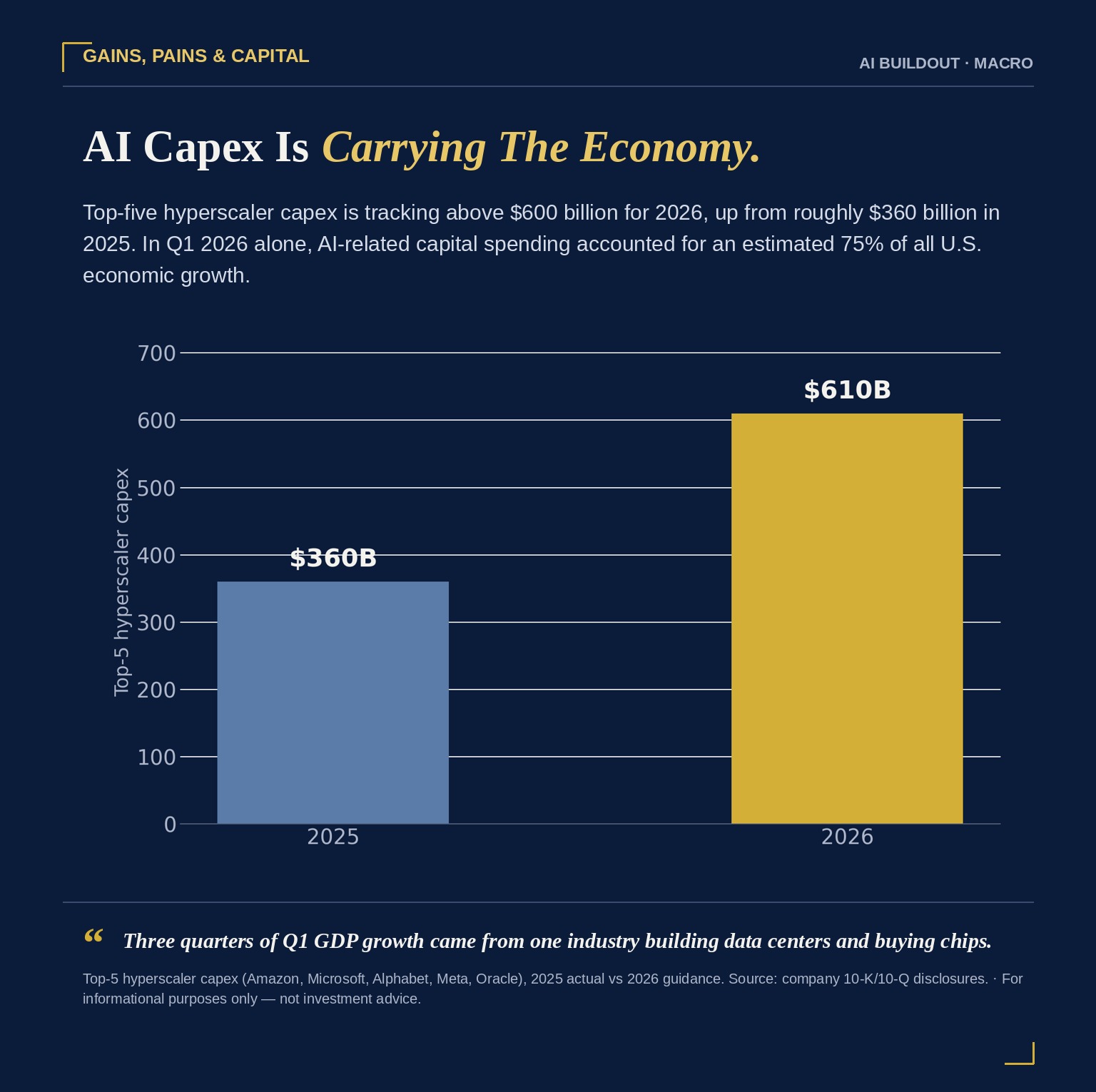
Start with the AI buildout itself. The top five hyperscalers, Amazon, Microsoft, Alphabet, Meta, and Oracle, are tracking above $600 billion in combined capex for 2026 alone, up from roughly $360 billion in 2025. BlackRock projects the broader AI infrastructure cycle will top $2.2 TRILLION by 2028. And this spending is not some abstract data point being pushed by hyperscaler CEOs to justify raising capital. It’s doing real, measurable work on the topline of the American economy. AI-related capex alone is on track to add roughly 2.5 percentage points to U.S. GDP growth this year. In the first quarter, AI capex accounted for an estimated 75% of ALL U.S. economic growth.
Read that again. Three quarters of the growth this country produced in Q1 came from one industry building data centers and buying chips.
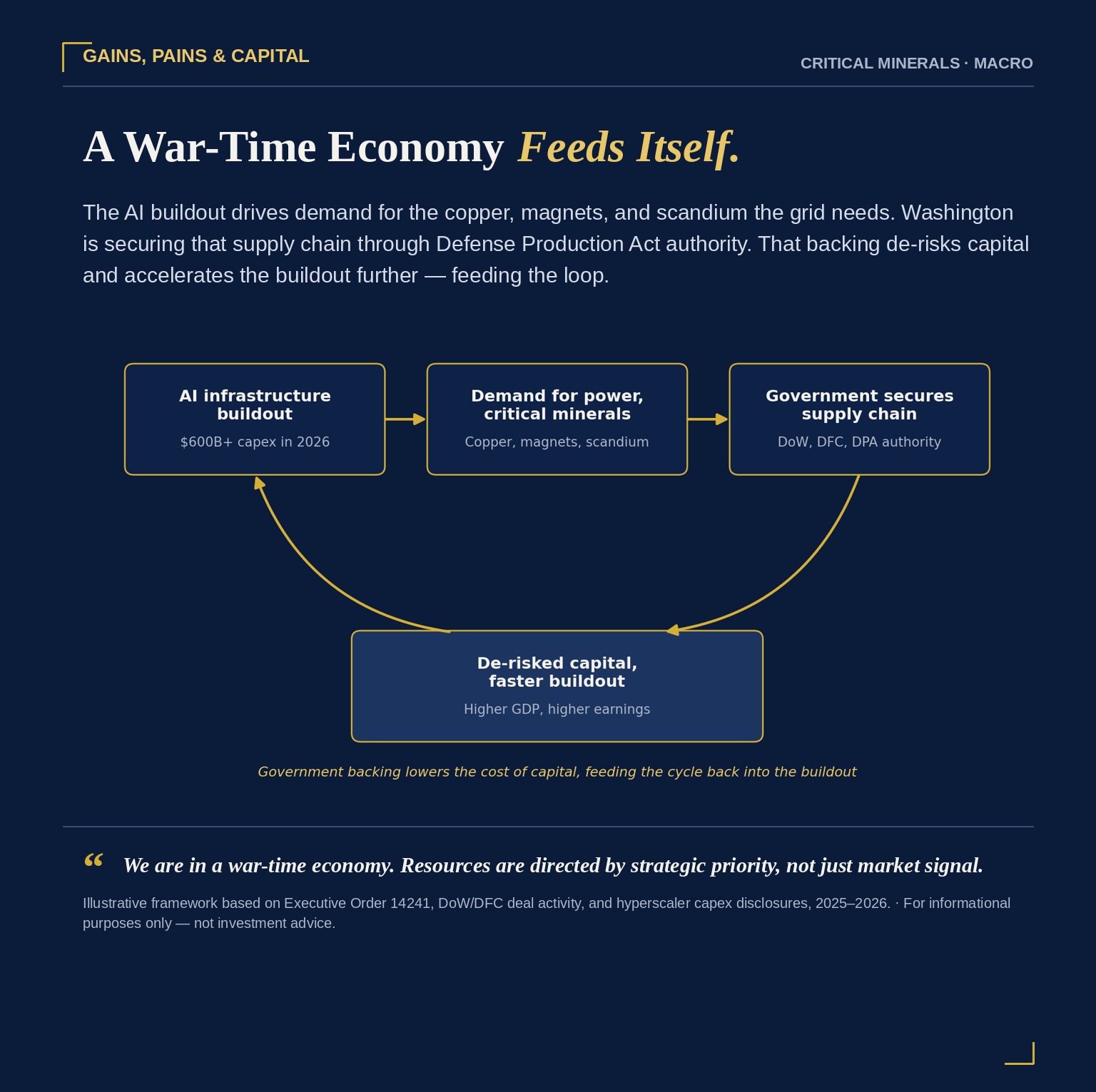
Now overlay the critical minerals push on top of that. Every one of those data centers needs power, and increasingly that means gas turbines, grid buildout, and new generation capacity, all of which runs straight through the same critical minerals supply chain we’ve been covering in this newsletter: scandium for fuel cells, rare earth magnets for turbines and cooling systems, copper by the truckload for every mile of new transmission line. The Trump administration isn’t treating the AI race and the critical minerals push as two separate initiatives. They’re the same initiative. You cannot win the AI race without the minerals to build the infrastructure, and you cannot secure the minerals without treating the supply chain as a national security matter, which is exactly what Executive Order 14241 and the mining roundtable were about.
This is why J.P. Morgan’s research desk has openly said AI capex is effectively locked in almost regardless of near-term stock performance. Inside the industry, this is understood as a U.S.-versus-China race nobody can afford to lose, and nobody backs off the gas in a winner-take-all race because of one rough earnings quarter. Once you see AI infrastructure and critical minerals as two fronts of the same fight, the sheer size of the spending makes a lot more sense. Wars, cold or hot, get funded regardless of quarterly optics.
That’s also why productivity, not just spending, is holding this economy up even with job growth flat. Real GDP averaged above 2.5% over the back half of 2025 even with negative headline job growth, because AI-driven productivity gains are increasingly doing the work labor used to do. Microsoft says 35% of its code is now written by AI. Meta cut 21,000 jobs while INCREASING output. S&P 500 revenue growth has slowed to around 5%, yet earnings per share are still growing at roughly 12% year over year, because margins keep expanding even as top-line growth cools. Slower revenue, expanding margins. That’s exactly what a genuine productivity boom looks like, and it’s a big reason the market keeps shrugging off headlines that would have tanked stocks in any other cycle.
Put it all together and here’s the picture: the federal government is running Defense Production Act authority to secure the physical inputs, minerals, metals, processing capacity, this buildout requires. The private sector is deploying capital at a scale this economy has never seen, treating the spending as close to non-negotiable given what’s at stake in the race with China. And real, measurable GDP and earnings growth is flowing directly out of that spending, propping up a market the skeptics keep insisting is overextended.
This is what a war-time economy actually looks like from the inside.
Nobody’s rationing butter or buying war bonds at the local bank. But resources are being directed by strategic priority instead of pure market signal, the government is intervening directly in supply chains it’s decided are critical, and enormous sums of capital are being committed regardless of near-term return because losing this race is considered unacceptable.
That’s the textbook definition of a war-time economic footing. It’s just pointed at silicon and rare earths instead of steel and rubber this time.
For where to put capital, that’s very bullish. War-time economies reward the companies sitting inside the supply chain the government and the hyperscalers both need, and they punish anyone sitting on the sidelines waiting for a better entry point. We’ve been positioning around exactly that intersection in this newsletter, and we’ll keep doing it as this plays out.
We will be detailing FIVE critical minerals plays with close ties to the Trump administration’s agenda in a new Special Investment Report that will be going out shortly. Each one of them is involved in the domestic production, refining, and processing of a critical mineral that the Trump administration has designated a matter of national security. When government priorities combine with market bottlenecks, fortunes can be made: the entire rare earths complex has more than DOUBLED in the last two years alone.
To reserve your copy of our upcoming Special Investment Report detailing FIVE critical minerals plays, all you need to do is susbcribe to our daily market commentary, Gains Pains & Capital. To do so…
Graham Summers, MBA
Chief Market Stragtegist
Phoenix Capital Research
