
Stocks had their worst week since June. The Nasdaq lost roughly 4.5%. The S&P 500 dropped close to 2%. Close to a trillion dollars came off the biggest AI and chip names in five trading days. Bitcoin broke below $82,000. Oil pushed through $100 and briefly touched $110. The VIX is ripping higher.
And so the doom and gloom crowd is back. The AI bubble is bursting. CoreWeave popped it. Get out now.
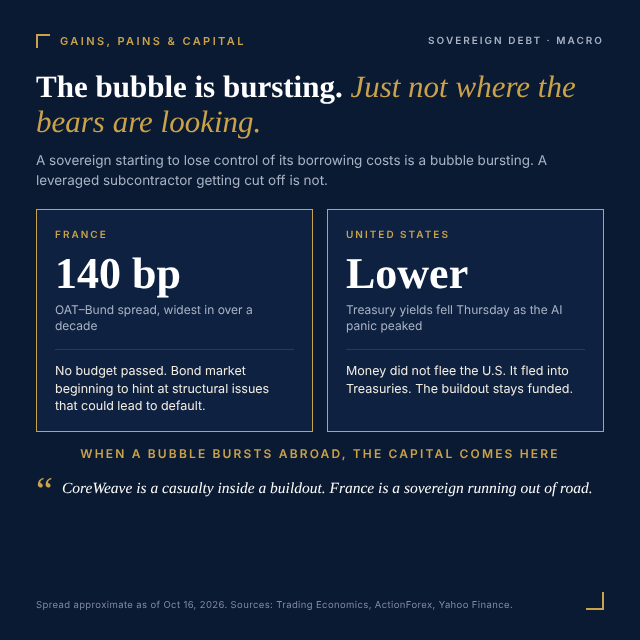
I want to be careful here, because I have been writing for weeks that the Everything Bubble is in fact bursting. It is bursting in France, where the government cannot pass a budget, the bond market is beginning to hint at structural issues that could eventually lead to a sovereign default, and the spread between French and German debt just broke out to levels not seen in over a decade. That is what a bubble bursting looks like. A sovereign starting to lose control of its own borrowing costs.
What happened to CoreWeave this week is something different. And the difference matters a great deal for how you invest.
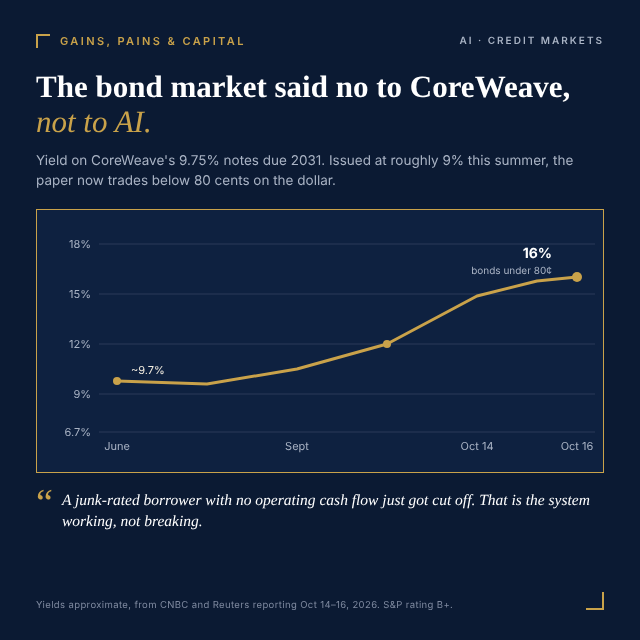
CoreWeave is a “neocloud.” It rents GPU capacity to companies building AI. It has taken on more than $51 billion in debt and obligations to do so. It carries a junk credit rating (B+). This week its bonds fell below 80 cents on the dollar, yields on its 2031 paper blew past 15%, and the cost to insure its debt against default hit a record. The stock fell 15% in a single session and kept falling.
That is a real problem for CoreWeave. It is a real problem for anyone who lent CoreWeave money at 9% thinking they were buying a safe return on the AI boom. Some of those lenders are going to lose money. CoreWeave itself may or may not make it through the next financing round.
But here is the thing. That is how a buildout works.
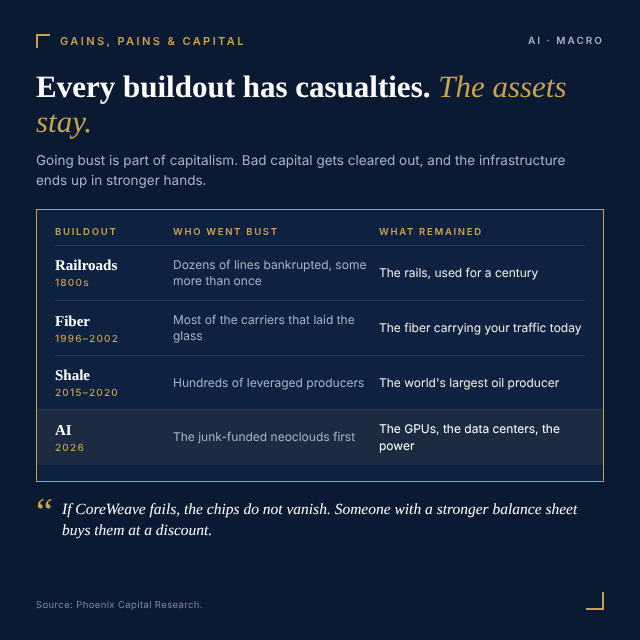
Every major buildout in American history has produced casualties along the way. The railroads were built by companies that went bankrupt, in some cases more than once, and the rails stayed in the ground and got used for a century. The telecom buildout of the late 1990s laid tens of thousands of miles of fiber. Most of the companies that laid it went bust. The fiber is still carrying your internet traffic today. The shale revolution bankrupted hundreds of producers between 2015 and 2020. The United States is now the largest oil producer on earth.
The pattern is always the same. A new technology shows up. Capital floods in. The most leveraged, most aggressive players build as fast as they can borrow. Some of them run out of runway before the cash flows arrive. They go bust, their assets get picked up for pennies by stronger hands, and the buildout continues under different ownership.
Going bust is part of capitalism. It is how the system clears out bad capital allocation and reassigns the assets to people who can actually make them pay. A market where nobody is allowed to fail is a market that has stopped working. The fact that the bond market just said “no more” to a junk-rated borrower with no operating cash flow is the system doing exactly what it is supposed to do.
So the question is not whether some AI players go bust. Some will. The question is whether the buildout itself stops. And I do not see how it does.
I have written at length about the fact that the U.S. is running a wartime economy. The Federal government is all in on AI. Compute first, then power, then applications, with the Pentagon as a first customer. That spending is being directed from Washington, backed by the Defense Production Act, executive orders, and a Treasury that has shown it will do whatever it takes to keep the machine running. The hyperscalers funding most of the data center capacity have hundreds of billions in annual cash flow. They do not need 15% money. The government does not issue junk bonds.
CoreWeave was a subcontractor in that story. A highly leveraged one that borrowed at junk rates to buy chips it hoped to rent out before the bills came due. If it fails, the GPUs do not vanish. The data centers do not get torn down. Someone with a stronger balance sheet buys them at a discount, and the capacity gets used.
Now layer in the inflation data, which is the other half of the bear case this week.
CPI came in at 3.7% for September. Oil is above $100 again after the latest Middle East attacks. Analysts are now openly discussing whether the Fed needs to hike. I have been writing that the U.S. would “run it hot” for well over a year. That is exactly what is happening. Inflation is not going away because Washington cannot afford for it to go away. The debt is too large to service in a deflationary environment.
And here is where France and CoreWeave come back together. On Thursday, when the panic in AI names was at its worst, Treasury yields tumbled. Money did not flee the United States. It fled into Treasuries. When a bubble actually bursts somewhere in the world, as it is in Paris right now, the capital comes here. That flow is what keeps the U.S. buildout funded even as individual players blow up. It is a big reason the bears keep getting the American side of this story wrong.
So what do you do with this?
You do not panic sell. A 4.5% drop in the Nasdaq after a historic run is a correction in the most leveraged, most crowded corner of the market. Earnings season starts in earnest next week, and the companies that actually make money from AI are about to report.
You do take the signal seriously. The free money phase of the AI trade is over. From here the winners are the players with real cash flow and real balance sheets, and the ones that go bust will be the ones who borrowed at junk rates to chase it. Pick accordingly.
And you do get positioned for an inflationary environment, because 3.7% CPI and $100 oil are telling you it is already here. Gold, energy, critical minerals, the companies that produce the physical inputs to a wartime economy. These are the assets that benefit when the government has decided the way out of the debt problem is to inflate.
That is precisely what I put together in my special report, Survive the Inflationary Storm. It lays out the hard assets and inflation beneficiaries I think are best positioned for what is coming, including specific names.
It normally sells for $499. I’m releasing 100 copies free to Gains, Pains & Capital readers today, and when they’re claimed the offer closes.
To pick up your copy, Click Here Now!
Best Regards,
Graham Summers, MBA
Chief Market Strategist
Phoenix Capital Research
