The United States is at war. Whether you like that or not does not change it, and pretending otherwise only opens you to your adversaries.
I am not talking about Iran. That is the war you can see on television, and it will end with a ceasefire. The war I mean is with China, it has no front and no end date, and it is the one that decides the next decade.
A central thesis of my work is that we are running a wartime economy for exactly this reason. It is not a black and white war with declarations and battle lines. It is a gray-zone war, and in a gray-zone war the prize is strategic assets: chips, critical minerals, shipping lanes, processing capacity, capital, and the people who control access to each of them.
Strip away the tabloid coverage and the Nvidia story is the clearest example of that war you will see this year. Here is the record as it has been reported, in the order it happened.
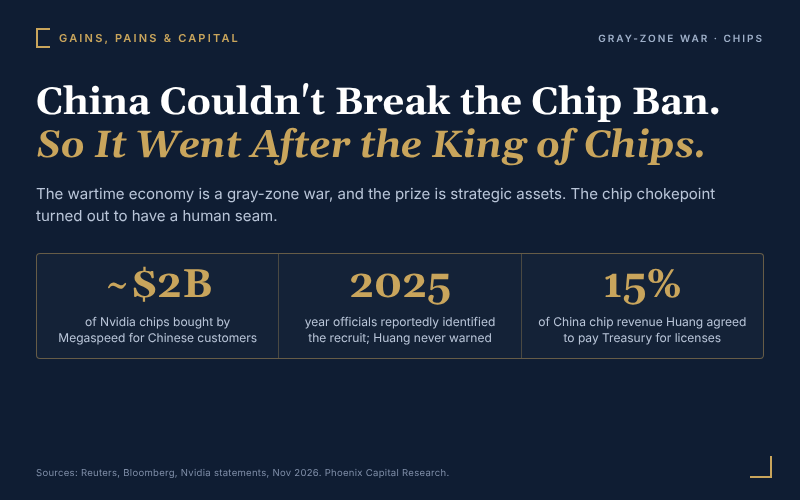
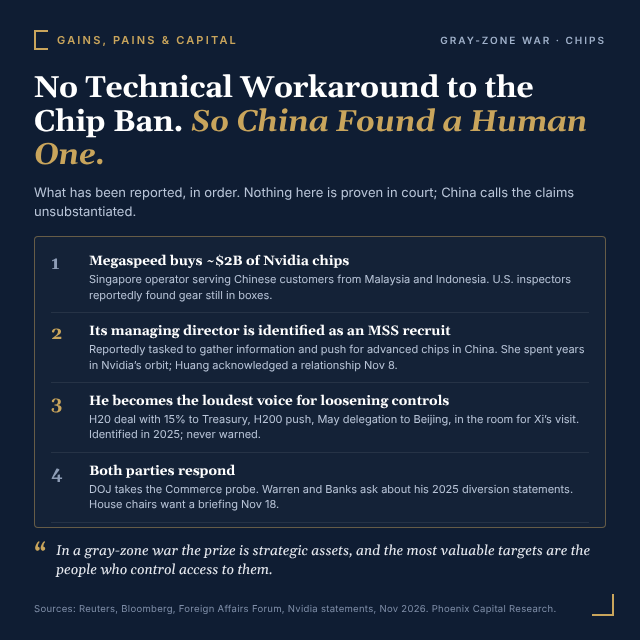
Alice Huang, a Chinese citizen also known as Huang Le, served as managing director of Megaspeed, a Singapore data center operator. Megaspeed bought roughly $2 billion of Nvidia processors for facilities in Malaysia and Indonesia serving Chinese customers. When U.S. officials inspected a Megaspeed site in Malaysia, they reportedly found the Nvidia equipment still in its boxes, uninstalled. That is what onward shipment looks like.
Megaspeed was the business side. The intelligence side is the part that matters. According to the reporting, U.S. intelligence identified Alice Huang through surveillance in 2025 and concluded she had been recruited by China’s Ministry of State Security. Her assignments were to gather information and to push for advanced American chips to be made available in China.
In the course of that surveillance, Jensen Huang, the founder and chief executive of Nvidia, turned up in intercepted communications with her. The President was briefed. Huang was not. He was never given a defensive briefing, the routine warning the government gives an American who has been targeted by a foreign service.
The story broke on October 29, when a major newspaper reported the intelligence findings. Nvidia’s first response was that Huang’s interactions with her were not unusual. Over the following week the reporting hardened. An intelligence memo described the relationship as romantic, and it had gone on for years.
On November 8, in a memo to employees, Huang acknowledged an extramarital affair, apologized, and said he would cooperate fully. The same day Nvidia’s board announced an independent investigation led by outside counsel. The board said it had no reason to believe national security or company secrets had been compromised and expressed confidence in his leadership. He continues to run the company during the review.
Washington moved faster than the board. The Commerce Department’s probe of Megaspeed has been taken over by the Justice Department. Senators Warren and Banks, one from each party, have asked Commerce whether Huang’s 2025 statements about chip diversion misled regulators. House committee chairs want him in a closed-door briefing on November 18.
None of this has been proven in court. China calls the claims unsubstantiated. But the shape of the operation is not in dispute, and the shape is the point.
Think about what China was up against. Since 2022 the United States has used advanced AI chips as its primary economic weapon against Beijing. The chips are designed in California, made in Taiwan, and sold by one company, so the chokepoint was total. The best technology-side answer China could produce was a smuggling network, and the Justice Department has been rolling those up one indictment at a time.
So China stopped attacking the technology and went after the one input the export regime could not control: the people.
The most valuable person in that system was the chief executive who had become the loudest voice in Washington for loosening the controls. Huang lobbied for H20 sales and struck the deal under which Nvidia paid the Treasury 15% of its China chip revenue for export licenses. He pushed for H200 sales to Chinese customers. He traveled with the U.S. delegation to Beijing in May and was in the room when Xi visited in September.
For two years, no single private citizen did more to argue that American chips belonged in China. And for most of those two years, according to the reporting, he was in a relationship with a woman U.S. intelligence believed was working for Beijing. Nobody warned him. The lobbying continued.
If the reporting holds, Beijing did not need to steal a design. It needed the man who negotiates chip access to the Chinese market to want what Beijing wanted, and it needed him to be arguing for it inside the White House. Whether any secret changed hands is almost beside the point. The target was his judgment, and his judgment was shaping American policy.
This is what gray-zone war looks like. Nobody declares anything. No missile is fired. Each side maneuvers for control of the assets the other cannot do without, using whatever tool works, and the tools include tariffs, export rules, equity stakes, sanctions, and intelligence services.
Seen that way, the Nvidia story is a campaign. The chip chokepoint was the strategic asset the U.S. believed it controlled completely, and the Ministry of State Security went after it the way an intelligence service goes after anything: by finding the seam. A seam is the joint where two parts of a defense meet, the one spot the designers never thought to armor because they were busy armoring everything else. Here the export controls covered the chips, the fabs, and the shipping routes, and left the private life of the man who argued chip policy wide open. The seam was human, and no export rule can patch it.
In a gray-zone war the most valuable targets are not factories. They are the people who decide what the factories are allowed to sell, and to whom. Last week the rest of the market found out what the people who study this for a living already knew.
And it may have toppled the king.
Nvidia’s board has expressed confidence in Huang, and he may survive the review. But the version of Jensen Huang that mattered to Beijing, the one who could walk into the Oval Office and win an argument about export controls, is gone regardless of what the investigation finds. No administration can now be seen taking his advice on China. Every statement he made about diversion in 2025 is going to be re-read.
Congress is going to tighten the rules whether or not he is cleared, because tightening them is now the only politically safe position in both parties. Nvidia, which earned nothing from China this year, is not going to earn anything from China for years.
Here is what that means for your money.
First, export controls get tighter, and the enforcement moves downstream. The Southeast Asian data center hubs that have been the back door for Chinese demand, Singapore, Malaysia, and Indonesia, are going to face end-use verification, licensing, and country-specific limits. Any company whose growth story runs through leasing GPUs to Chinese customers from Kuala Lumpur has a problem.
Second, the sovereign compute trade gets pulled forward. If chips can be compromised through the people who sell them, the answer governments will reach for is capacity they control: domestic data centers, allied-only supply chains, and the Pentagon as the anchor customer. That is the third phase of the wartime economy I have been describing, and it just acquired a national security justification that nobody in Washington will argue against.
Third, the chokepoint strategy itself is going to be re-examined. A weapon that can be turned by one relationship is not as strong as the people wielding it believed. The U.S. is dependent on China for critical minerals processing, and China has now shown it will use the human seam. The companies building allied processing capacity outside China just became more important, not less.
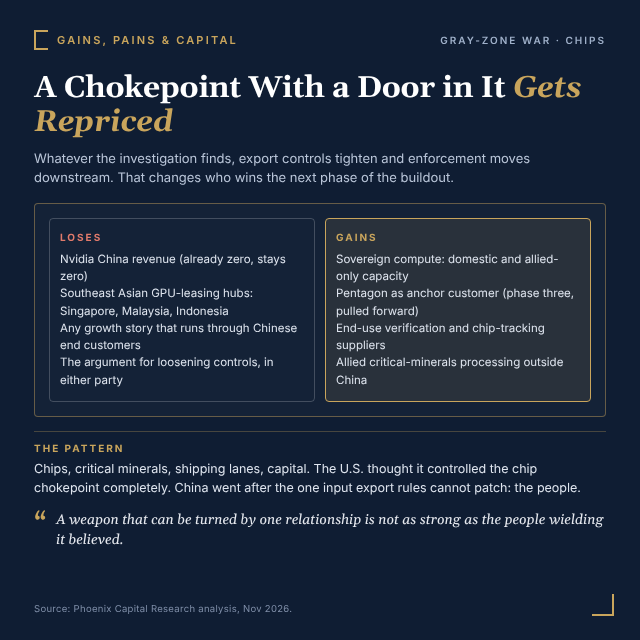
The market treated Nvidia’s drop on Monday as a scandal discount. Look closer and it is the first repricing of a chokepoint that turned out to have a door in it. The Chinese found the door before we did.
There is one more thing to take from this, and it is the part that will show up in your cost of living.
Every seam, once found, has to be sealed. And sealing a seam is never free. A $20,000 drone in the Middle East forces a navy to fire a multi-million-dollar interceptor at it, to station more ships, and to build an entire new layer of defense around a threat that costs less than a used car. The drone did not have to win. It only had to make everything on the other side more expensive.
The same thing is now happening to the chip business. The export regime is going to add end-use verification, licensing, audits, and counterintelligence vetting of the people who negotiate access to the Chinese market. Tech executives who have spent two decades flying to Beijing unescorted are about to get handlers, briefings, and lawyers. Every one of those measures slows something down, and everything that slows down costs more.
That is the pattern of a gray-zone war. Fragility gets discovered, assets get thrown at it, and the economy that pays for them gets more expensive to run. It happened to shipping after the Red Sea. It is happening to critical minerals as the West rebuilds processing it let China own. It is now happening to the executives who run the most valuable companies in the world. None of it shows up in the Fed’s models, and all of it shows up in prices.
This is precisely why I put together a special report called Survive the Inflationary Storm. It outlines how inflation is going to play out over the next 12 months, which assets will come out ahead, and specific investments to own as a wartime economy makes everything cost more.
It normally sells for $499. I’m releasing 100 copies free to Gains, Pains & Capital readers today, and when they’re claimed the offer closes.
To pick up your copy, Click Here Now!
Best Regards,
Graham Summers, MBA
Chief Market Strategist
Phoenix Capital Research
