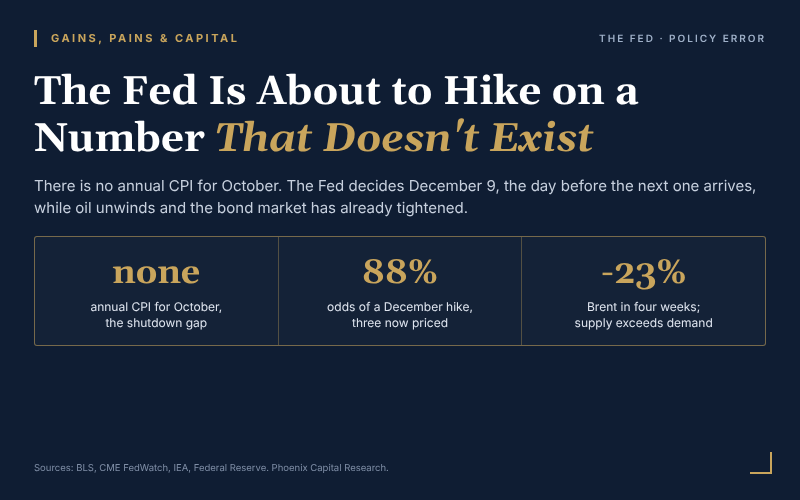
On December 9 the Federal Reserve will almost certainly raise interest rates. Futures put the odds at 88%. Governor Waller has floated a half-point move. The market is now pricing three hikes in a row, December, January, and March.
Here is what almost nobody has noticed. When the Fed makes that decision, it will not know what the annual inflation rate is. Nobody will. The number does not exist.
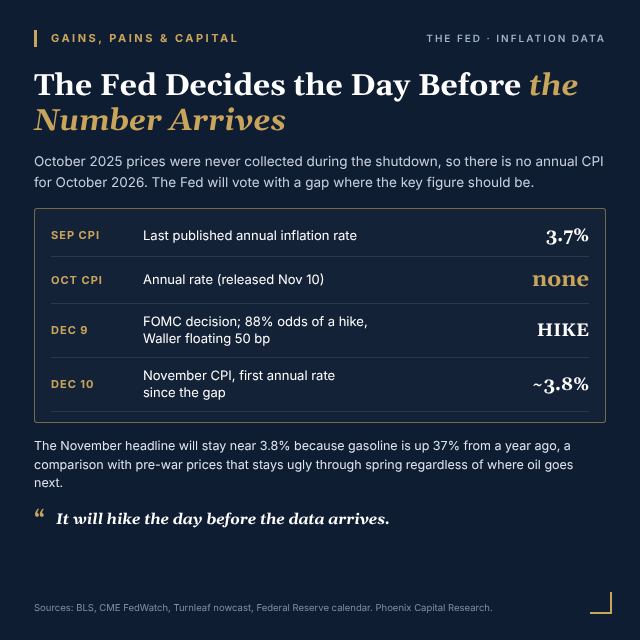
The Bureau of Labor Statistics never collected October 2025 prices. The government was shut down that month, the field staff stayed home, and the data was never gathered. A year later that means there is nothing to compare October 2026 prices against, so when the October CPI came out last Tuesday it had a monthly change (up 0.4%) and no year-over-year rate at all. The last annual figure anyone has is September’s 3.7%, and September is two months and one oil reversal ago.
The November CPI, the first with a real annual rate since the gap, comes out December 10. The Fed decides on December 9. It will hike the day before the data arrives.
That alone should make you uneasy. What makes it a policy error is what the data will say when it does arrive, and what the Fed will have already done about it.
Start with oil, because oil is the whole inflation story this year. The Iran war began in February. Brent went from the $70s to over $100 and dragged every price index up with it. Gasoline is still up 37% from a year ago. But over the past four weeks Brent has fallen 23%, to around $92, and the International Energy Agency reported this week that global supply exceeds demand for the first time since the war began. The input that drove inflation higher is now going the other way.
The official numbers will not show that for months. The November CPI will print a headline rate near 3.8% almost entirely because gasoline is being compared with a year ago, before the war, and that comparison will stay ugly through the spring no matter what oil does from here. The Fed will be hiking on a number describing a price shock that is already fading.
Real-time data saw the shock arrive, and it will see it leave. Truflation, which tracks millions of prices daily rather than surveying them once a month, rose from 2.27% at the end of August to 3.26% by October 28, and it moved in four distinct one-day steps, each on an oil spike. That is what inflation driven by a single input looks like, and an index that catches it going up will catch it coming down weeks before the BLS does. By the time the Fed’s preferred data confirms that inflation has turned, it will have hiked twice.
Now look at what the market has already done to borrowing costs without the Fed’s help. The 10-year Treasury yield jumped 24 basis points last week to 5.1%. Set that against a real-time inflation rate of a bit over 3% and you get a real long-term rate approaching 2%, the highest of this cycle. The 30-year mortgage follows the 10-year, not the fed funds rate. Corporate borrowing follows the 10-year. The long end of the curve has been tightening on its own since September, and it did so during the same month hedge funds cut their AI exposure from 47% of their books to 32% and the Nasdaq 100 fell 6%.
Put the pieces together. Inflation’s driver is reversing. Market rates have already risen sharply. Leverage has already come out of the most crowded trade in the world. And the Fed, working off a lagging index with a hole in it, is preparing to tighten three more times.
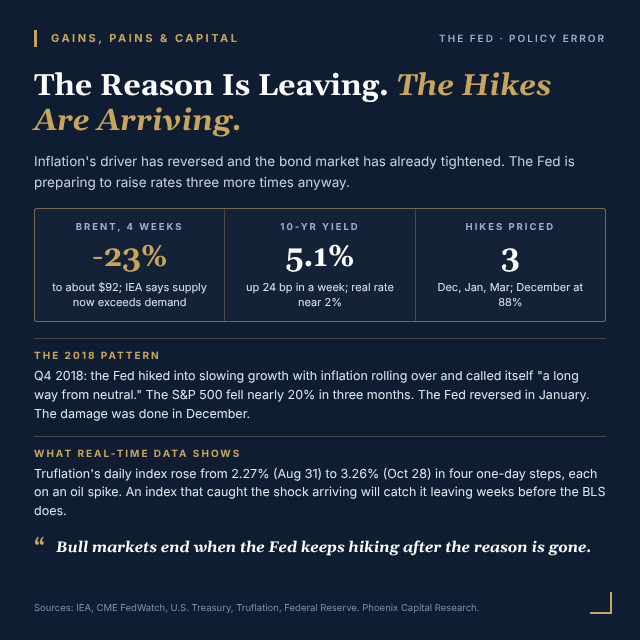
This is how bull markets actually end. They do not end because the Fed raises rates once. The S&P 500 has absorbed plenty of single hikes. They end when the Fed keeps raising rates after the reason has gone away, because it is looking at data that describes the past. In the fourth quarter of 2018 the Fed hiked into a slowing economy with inflation already rolling over, told the market it was “a long way from neutral,” and the S&P fell nearly 20% in three months. The Fed reversed in January. The damage was done in December.
The setup today is the same shape with worse information. In 2018 the Fed at least had a complete inflation series to be wrong about. This time it has a gap where the most important number should be, a war premium unwinding in real time, and a Governor talking about 50 basis points.
I want to be fair about why they are doing it. The Fed got inflation wrong in 2021 by calling it transitory and waiting, and every person on that committee remembers it. Producer prices are still running above 6%. The public is still angry about grocery bills. A central bank that just lived through one credibility crisis will take the risk of overtightening over the risk of being called soft again, every time. That is a rational institutional choice. It is also exactly how policy errors get made.
So here is my call, and I will put a date on it. If the Fed hikes on December 9 and signals that January is live, the S&P 500 does not make a new all-time high before the March meeting. The market will spend the first quarter repricing a Fed that is fighting last quarter’s inflation, and the sectors that led the bull market, the ones most sensitive to the long end of the curve, will lead it down.
What would make me wrong: a pause in December, or oil back above $105, which would make the hikes justified rather than mistaken. I do not expect either. The committee has talked itself into December, and the oil market has turned.
What to do about it is not complicated. Stop assuming the Fed will rescue the market, because this Fed has told you it won’t. Watch the 10-year, not the fed funds rate, because that is where the tightening is actually happening. And own the things that do well when a central bank makes a mistake in the direction of too tight: cash yielding 4%, duration once the hiking stops, and the assets that get repriced when the Fed is forced to reverse.
The Fed is about to raise rates on a number that doesn’t exist, to fight an oil shock that is already fading, while the bond market has done the job for it. You do not need to predict the exact top to see that this is how tops are made.
This is precisely why I put together a special report called Survive the Inflationary Storm. It outlines how inflation is going to play out over the next 12 months, which assets will come out ahead, and specific investments to own when the Fed is fighting last quarter’s inflation with next quarter’s rate hikes.
It normally sells for $499. I’m releasing 100 copies free to Gains, Pains & Capital readers today, and when they’re claimed the offer closes.
To pick up your copy, Click Here Now!
Best Regards,
Graham Summers, MBA
Chief Market Strategist
Phoenix Capital Research
