Seven months ago, Iran closed the Strait of Hormuz and the oil market assumed the Gulf would be hostage until the war ended.
This week the data came in, and the map has flipped.
According to Kpler’s tanker tracking through September 28, crude exports from the Gulf producers other than Iran averaged at least 16.5 million barrels a day in September. That matches their pre-war average. In the final week of the month they went above it.
Iran’s exports over the same period: zero. Not a single new cargo has crossed the U.S. blockade line since mid-July. Tehran has cut production roughly in half, to about 1.8 million barrels a day, which is what the country burns at home. Kpler estimates its oil revenue effectively hits zero in three to four months. And Treasury has started going after the foreign banks Iran uses to collect what it already sold.
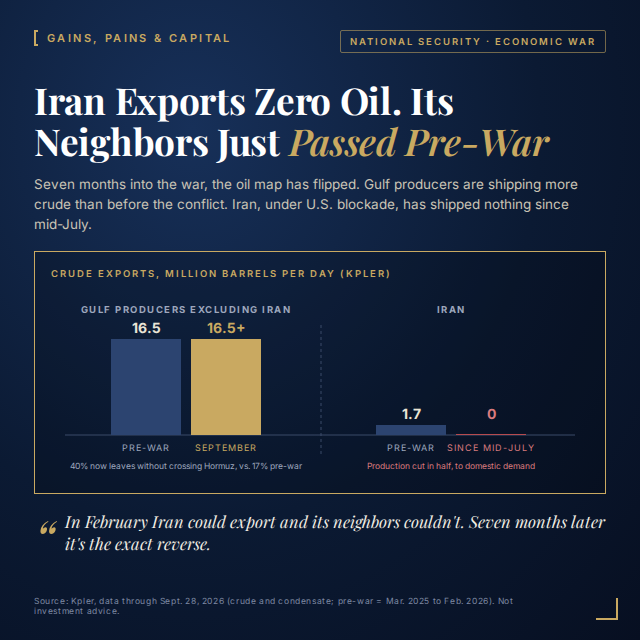
Kpler’s own analyst put it best: in February, Iran could export and its neighbors couldn’t. Now it’s the exact opposite.
Here’s how it happened. Forty percent of Gulf crude now leaves the region without crossing Hormuz at all, up from 17% before the war. The Saudis run the East-West pipeline to the Red Sea. The Emiratis run their pipeline to Fujairah on the Gulf of Oman. The rest moves through the lane the U.S. Navy carved out along the Omani coast, with more than a hundred vessels under escort. Washington didn’t win the Strait. It made the Strait less important, and then it blockaded the one country that still depended on it.
That’s an extraordinary result, and I want to give it its due before I tell you why it isn’t the whole story.
Because here is the part the victory lap misses.
The fifth tanker of the week was hit on Thursday. It was hit inside the U.S.-protected lane. According to the New York Times, Iran has averaged roughly 30 drone attacks and 10 anti-ship missile launches a week since early August, and more than a dozen ships have been struck since September 10. The Saudi pipeline that makes the 40% figure possible was knocked offline for eleven days by a single drone launched from Iraq. The Houthis put a ballistic missile toward Khamis Mushait this morning.
And Brent is still above $100 a barrel with Gulf exports at pre-war levels.
Think about what that means. The supply is back. The price isn’t. The difference is a risk premium, and the market is charging it because a country with zero oil revenue and a collapsing economy can still put a $20,000 drone into a supertanker inside a lane guarded by the most powerful navy on earth. The U.S. has built a brilliant workaround, but a workaround that requires a carrier group, a hundred escorted ships, and two pipelines to replace what one strait used to do for free is not a return to the old world. It’s a more expensive one.
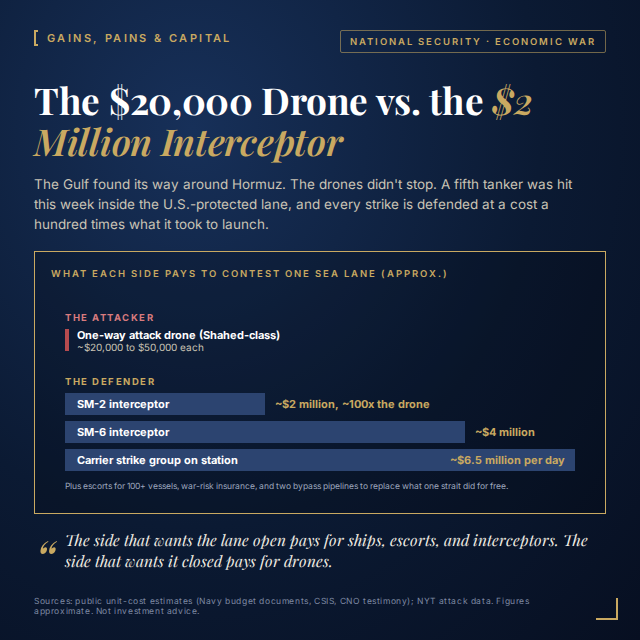
That’s the real lesson of this war, and it’s bigger than Iran. Cheap, mass-produced autonomous weapons have permanently changed the cost of keeping a chokepoint open. The side that wants the lane open has to pay for ships, escorts, interceptors, and insurance. The side that wants it closed pays for drones. The asymmetry doesn’t go away because the lane is working. It just gets priced into everything that moves through it.
Which brings me to China.
Beijing has watched all of this. It has watched the U.S. zero out the oil exports of a country of 90 million people in sixty days with a naval blockade, and it has watched a country with no navy to speak of impose a $20-a-barrel premium on the world’s largest producers for seven months with drones. Both of those lessons apply to China directly.
The first one is the threat. China imports roughly three-quarters of its oil, and most of it comes through the same kind of chokepoints: Hormuz, then Malacca. Washington just demonstrated, in public, that it can and will shut a country’s oil exports to zero. Every planner in Beijing understands that the same tool points at Chinese imports. Expect China to accelerate what it was already doing: filling strategic reserves, building overland pipelines from Russia and Central Asia, and pushing its own version of the 40% bypass.
The second lesson is the opportunity, from Beijing’s perspective. If Iran can do this to the Gulf with a few hundred drones a month, imagine what a country that manufactures the world’s drones can do to the Western Pacific. That’s the scenario the Pentagon’s new Autonomous Warfare Command exists for, and it’s why Hegseth gave Musk and Luckey 120 days to map it. The Hormuz campaign is the proof of concept that both sides are now studying.
So what does this mean for you as an investor?
First, don’t mistake the recovery in Gulf exports for the end of the energy risk premium. Oil above $100 with supply at pre-war levels is the market telling you the premium is structural. The companies that get paid for that premium, the exporters and the infrastructure that bypasses chokepoints, keep getting paid.
Second, the next phase of the Iran war is now on the calendar. The Wall Street Journal reported overnight that the U.S. plans to resume bombing by the end of November, with up to 10,000 more troops and a third carrier. Iran’s revenue clock runs out on roughly the same timeline. Either Tehran folds or it escalates, and the market is pricing the second one.
Third, the cheap-weapon asymmetry is the trade of the decade. Every navy, every shipper, every insurer, and every government with a chokepoint to defend just learned what it costs to keep one open. The money goes to counter-drone systems, autonomy, the sensors and chips inside them, and the critical minerals they’re built from. The U.S. is buying. China is buying. The suppliers get paid either way.
The Gulf found its way around Iran. That part is over. What the drones taught the world about the price of a sea lane is just getting started.
One more thing to understand about a world where a $20,000 drone forces a carrier group to stay on station at $6.5 million a day. Somebody pays for that. The Navy pays, the shippers pay, the insurers pay, and all of it lands in the price of oil and the size of the deficit. A government that has to buy its way around every chokepoint is a government that cannot stop spending, and inflation becomes the way the bill gets settled.
That’s why I wrote a Special Investment Report called Survive the Inflationary Storm. It lays out what happens to stocks, bonds, and cash when the world gets structurally more expensive, which sectors collect the premium instead of paying it, and the five specific investments I want you holding while this plays out, including one that profits directly from the asymmetry you just read about.
It normally sells for $499. I’m releasing 100 copies free to Gains, Pains & Capital readers today, and when they’re claimed the offer closes.
To pick up your copy, Click Here Now!
Best Regards,
Graham Summers, MBA
Chief Market Strategist
Phoenix Capital Research
