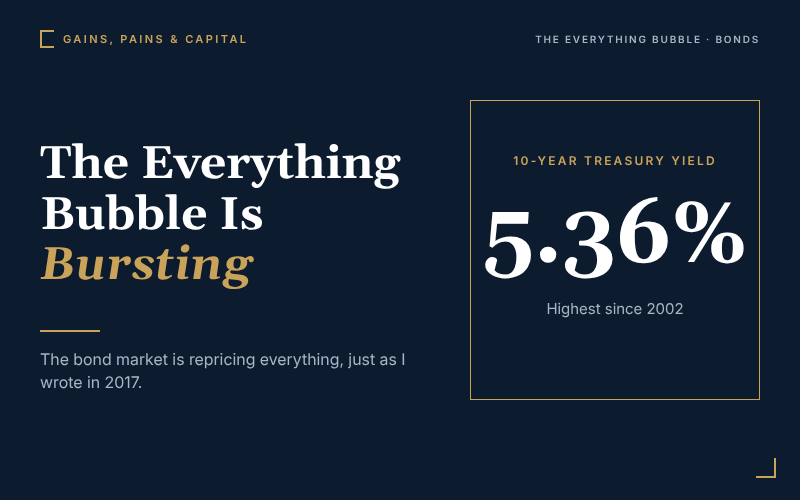
In 2014, I coined a term to describe what the Federal Reserve was doing to the financial system: the Everything Bubble.
Three years later, I wrote the book on it. Literally. The Everything Bubble: The Endgame for Central Bank Policy explained exactly how the Fed had put the entire financial system in a bubble, and what would happen when it burst.
Today, “the Everything Bubble” is part of Wall Street’s vocabulary. The term has appeared in the Wall Street Journal, the New York Times and the Economist. Scott Bessent, who went on to become Treasury Secretary, even used it in the title of a 2023 essay. Plenty of people now use the phrase. I’m the one who wrote the book on it, and the core idea in that book is one most of Wall Street still hasn’t absorbed.
U.S. Treasuries are the bedrock of the financial system. Their yields serve as the “risk-free rate” that every other asset is priced against. So when the Fed spent a decade forcing Treasury yields to record lows, it created a bubble in bonds and in everything priced off of bonds: stocks, real estate, credit, all of it.
The corollary was just as simple. When the bond bubble bursts, everything priced off of it has to reprice.
That process is now well underway.
This week the 10-Year Treasury yield hit 5.36%, its highest level since 2002. In 2020, that same yield was near 0.5%. The 30-Year is near 5.7%. And the Fed, which cut rates six times between September 2024 and December 2025, raised them last month for the first time since 2023. Minutes released this week show most Fed officials expect another hike by year end.
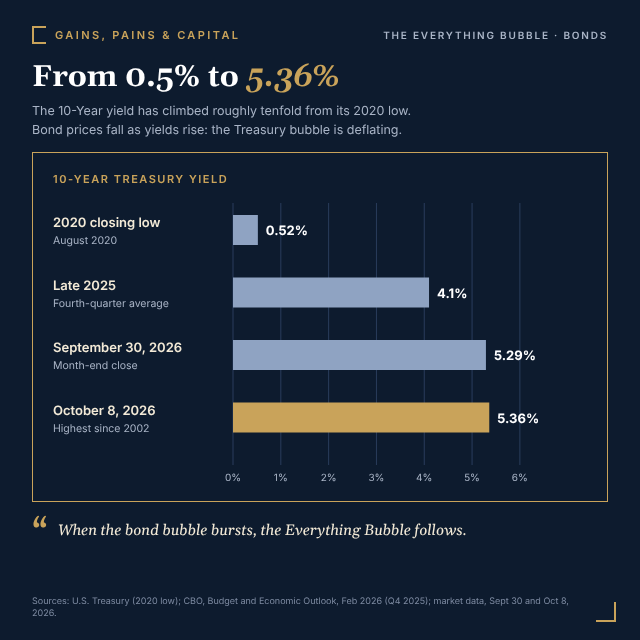
Bond prices move inversely to yields. Put simply, the bubble in Treasuries is deflating in real time.
I’ve been warning about this moment for years. In January 2018, when the 10-Year broke above its 20-year downtrend, I wrote that when the bond bubble bursts, the Everything Bubble follows. The Fed bought time in 2020 by driving yields back to record lows. But time is all it bought.
Right now the financial media is treating 5% yields as a Fed story or an oil story. Both play a role. The bigger story is what rising yields do to the price of everything else.
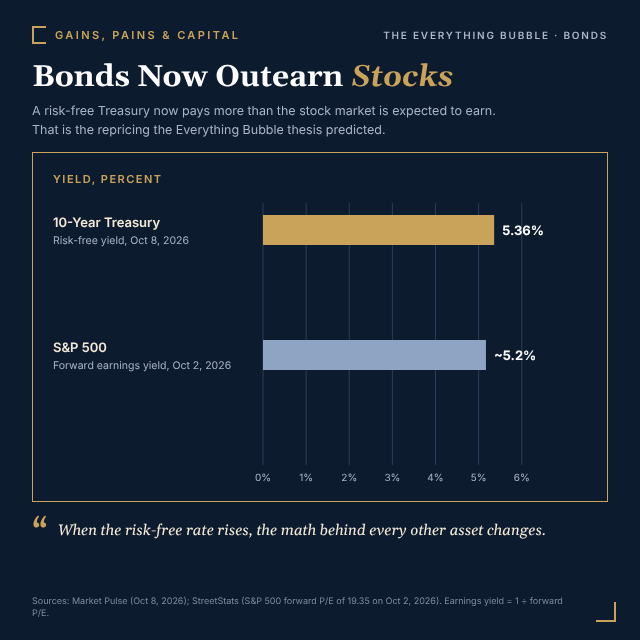
Start with stocks. As of last week, the S&P 500 traded at roughly 19.4 times forward earnings. Flip that around and stocks offer an expected earnings yield of about 5.2%.
The 10-Year Treasury now pays 5.36%, with no earnings risk at all.
Think about what that means. A risk-free government bond now pays investors more than the stock market is expected to earn. That is exactly the repricing The Everything Bubble described: when the risk-free rate rises, the math behind every other asset changes.
Stocks have held up so far because earnings are booming. Analysts expect S&P 500 earnings to grow more than 30% this year, largely on the back of the AI buildout. That is a real tailwind. But it also means the market is leaning heavily on one engine, and the bar for that engine rises with every basis point on the 10-Year.
The second piece most people are missing is the federal government itself.
When the Congressional Budget Office (CBO) put together its budget projections in February, it assumed the 10-Year would rise only gradually, to 4.3% by the end of 2027, and that the Fed would keep cutting. Instead, the 10-Year is above 5.3% and the Fed is hiking.
That gap is enormous. In August, annual federal interest costs topped $1 trillion for the first time ever. By one estimate based on CBO figures, rates running just one percentage point above the CBO’s assumptions would add $3.2 trillion in interest costs over the next decade. More interest means more borrowing, and more borrowing means more Treasury supply for the market to absorb.
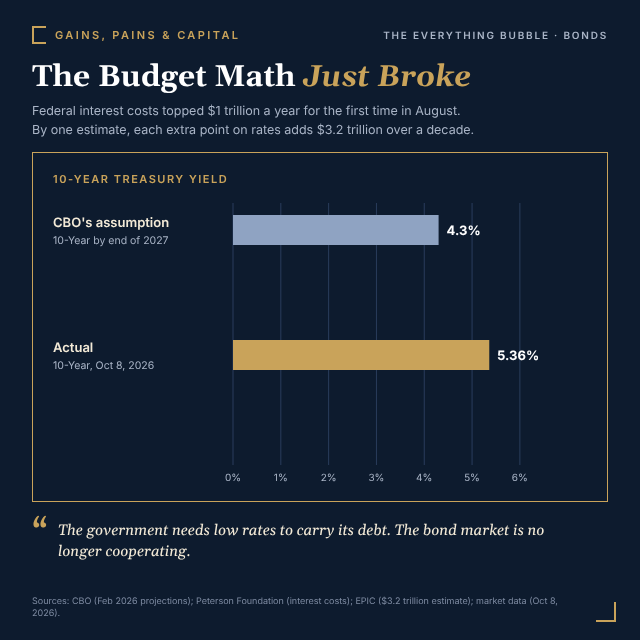
This is the feedback loop at the heart of the Everything Bubble. The government needs low rates to carry its debt. The bond market is no longer cooperating.
You can already see the effects spreading through the system. Credit spreads widened in September, mortgage rates climbed and delinquencies on commercial mortgage-backed securities crossed 8%.
Overseas, France is the first major government the bond market is putting to the test. Its 10-Year yield came within a hair of 5% last week, its highest level since 2002. France is now paying more to borrow than Italy or Greece, and the gap between French and German yields is near levels last seen during the 2011 euro crisis.
France can’t count on a rescue. The European Central Bank’s bond-buying backstop only applies when a country’s rising yields aren’t justified by its fundamentals. With France running a budget deficit above 5% of GDP, it doesn’t qualify. This week the governor of the Banque de France said as much: the conditions for an ECB intervention aren’t met.
Compare that to Japan. When the yen plunged to a 40-year low this summer, the U.S. Treasury did something it almost never does. It bought yen alongside Japan’s government in a joint intervention. Treasury Secretary Scott Bessent later said the U.S. would do “whatever it takes” to support Japan.
Why the difference? Japan is the largest foreign holder of U.S. Treasuries. If Tokyo had been forced to sell Treasuries to defend its currency, U.S. yields would have climbed even faster. In other words, Washington stepped in for Japan to protect its own bond market. France gets no such help.
That tells you exactly where we are in the Everything Bubble. Governments are now defending their bond markets wherever they can, and the ones without a backstop are the first to be tested.
None of this means stocks collapse tomorrow. Bubbles rarely burst in a single day, and this one is deflating from the foundation up. But it is a major signal, and investors who position for it now will be far better off than those who wait for the headlines to catch up.
That means favoring real assets and businesses with pricing power and strong balance sheets, keeping bond exposure short, and being cautious with anything that only works when money is cheap. The assets that thrived when the risk-free rate was near zero are the ones most exposed as it climbs.
If you want to understand how we got here, and what the endgame looks like, I laid it all out in The Everything Bubble: The Endgame for Central Bank Policy. I wrote it in 2017. The roadmap it describes is playing out right now.
There is one more piece to this puzzle, and President Trump just said the quiet part out loud.
In an interview with TIME published last week, the President was asked how Washington could reduce its debt burden. His answer: “Certain levels of inflation will also pay off that debt very rapidly. Very rapidly.”
Think about what that means. The U.S. now owes roughly $40 trillion. There are only a handful of ways to deal with a debt that size: cut spending, raise taxes, grow your way out of it, or inflate it away. Inflation shrinks the real value of what the government owes, and it does so at the expense of savers and bondholders.
It is the oldest move in the playbook for governments buried in debt. And when the President openly says inflation will pay down the debt, the bond market listens. It is one more reason investors are demanding higher yields to lend Washington money.
Investors should take the President at his word and position accordingly. To help you do that, I recently put together a special report titled Survive the Inflationary Storm. It details the investments I believe are best positioned to profit as inflation takes hold, including several with the potential to be huge winners.
It normally sells for $499. I’m releasing 100 copies free to Gains, Pains & Capital readers today, and when they’re claimed the offer closes.
To pick up your copy, Click Here Now!
Best Regards
Graham Summers
Chief Market Strategist
Phoenix Capital Research
