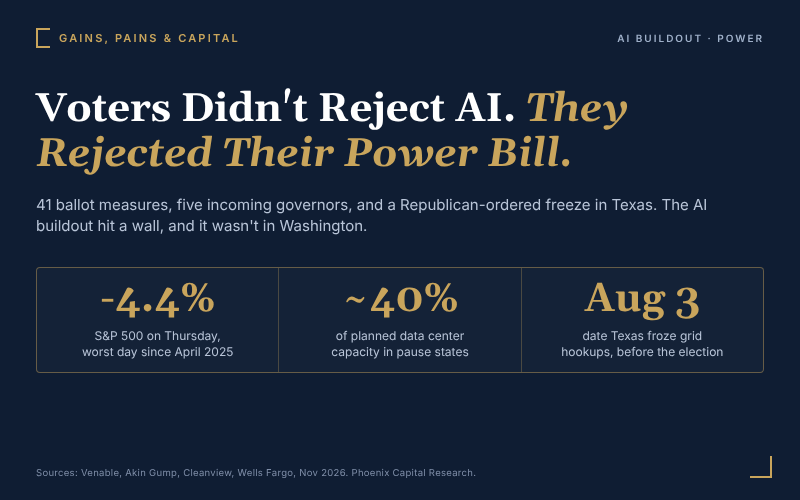
Thursday was the worst day for stocks since April 2025. The S&P 500 fell 4.4%, the Nasdaq 100 fell 6.4%, and the semiconductor index dropped 12%. Roughly $3 trillion in market value disappeared in a session.
The explanation making the rounds is that the AI bubble met a blue wave. Both halves of that are wrong, and getting it wrong will cost you money.
Start with what actually happened on Tuesday. Voters in ten states decided 41 local ballot measures on data center development, and the results ran almost unanimously against the data centers. Ohio alone had 13 approved measures, and they were not subtle: Granville, Hubbard, and Urbana banned data centers outright. Conneaut, Defiance, and Sunbury capped them at 25 megawatts. Grove City now requires a public referendum for any large industrial project. Maine towns passed retroactive moratoriums. Kansas towns banned anything over 25 megawatts. Edgewater, Florida amended its charter to bar new data centers from being approved, built, expanded, or operated.
Then the governors. The incoming governors of Ohio, Georgia, Michigan, New Mexico, and Texas all campaigned on pausing or restricting new data center construction. New York’s statewide moratorium has been in place since July, and the new governors of New York and Oregon ran on extending the ones they already have. Wells Fargo estimates 27% of all planned U.S. data center gigawatts sit in Texas alone. Cleanview, a market intelligence firm, puts roughly 40% of planned national capacity in the states that just voted for a pause.
Now the part everyone is skipping. The Texas pause did not start on Tuesday. On August 3, Greg Abbott, a Republican, ordered ERCOT to halt every data center in its interconnection queue pending a statewide audit of power supply, on-site generation, water use, and tax incentives. Projects that fail the audit “must be denied” grid connection. Gina Hinojosa beat him on Tuesday promising to keep that pause in place. She will not need a new law. The freeze is already there, and it was put there by the other party.
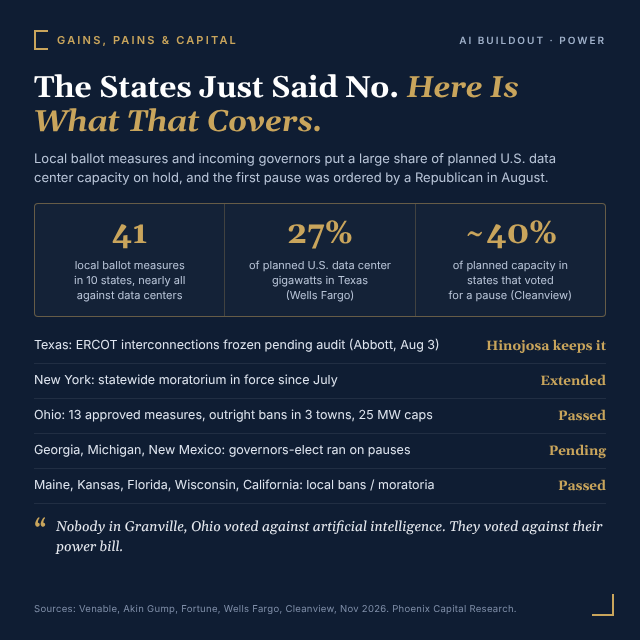
Nothing about this is partisan, and nothing about it is anti-technology. Nobody in Granville, Ohio voted against artificial intelligence. They voted against a 300-megawatt facility next to the high school that would be first in line for the local utility’s power while their own bills went up to pay for the transmission upgrades. That complaint does not have a party, and it is going to show up in every state where a hyperscaler wants to plug in.
Here is why this matters more than one bad week in the Nasdaq.
I have written for months that the U.S. is running a wartime economy, with the federal government directing capital into the AI buildout in three phases: compute first, then power, then application. Phase one is done. Washington funded the chips, and the chips are being made. Phase two, power, is the hard part, and last week Elon Musk said out loud what the industry has known all year: by the end of 2026 the U.S. will be producing more AI chips than it can turn on, because chip output is compounding and electricity supply is flat.
What Tuesday added is that phase two is not Washington’s call. The federal government can fund fabs and subsidize chips. It cannot site a substation, approve a gas plant, or connect a data center to the grid. Those decisions belong to governors, public utility commissions, and town councils, and a meaningful share of them just said no. The wartime economy ran into federalism, and federalism won the first round.
The buildout survives this. What changes is its shape, and the reshaping is where the money is.
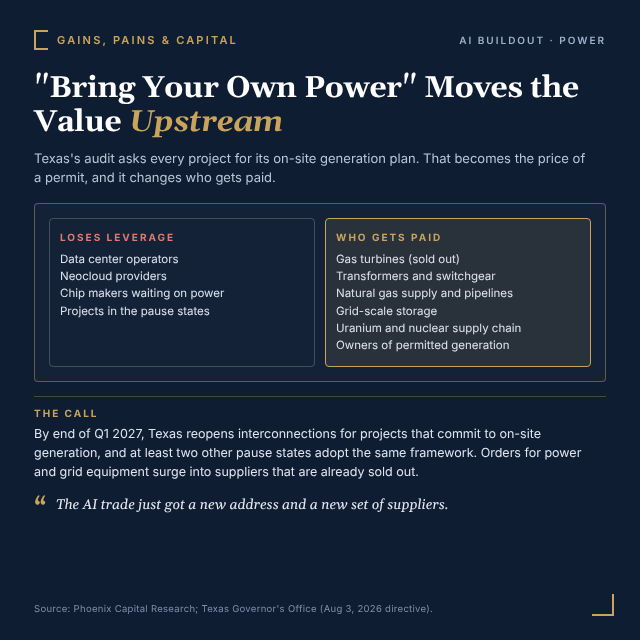
The hyperscalers have a trillion dollars committed and chips arriving on trucks. They are not going to abandon the projects. They are going to do whatever the pause states demand to get reconnected, and the Texas audit already tells you what that is. Abbott’s order specifically asks every project in the queue to document its on-site generation and the measures it will take to reduce grid demand. Read that as the new price of admission. The data centers that get built from here will be the ones that bring their own power: gas turbines on site, battery storage, small nuclear where it can be permitted, and private transmission that does not touch the residential grid. “Bring your own power” is about to go from a nice-to-have to a condition of the permit.
That moves the value upstream, away from the data center itself and toward everything that lets a data center exist without angering a voter. Gas turbines, which already have multi-year backlogs. Transformers and switchgear, same story. Natural gas supply and the pipelines that deliver it to a site. Grid-scale storage. Uranium and the nuclear supply chain, which the pause states will discover is the only large-scale option that does not raise anyone’s bill. And the companies that already own permitted generation with an interconnection in hand, because that asset just became scarce.
Notice who fell hardest on Thursday: the chip makers and the neocloud operators, the companies whose business depends on being able to turn servers on. The equipment makers fell too, but they are the ones who get paid to solve the problem. That is the gap to trade.
So here is my call, and I will put a date on it.
By the end of the first quarter of 2027, Texas will resolve its audit by reopening interconnections for projects that commit to on-site generation and grid-demand reduction, and at least two of the other pause states will adopt the same framework. The practical result is a multi-year surge in orders for power generation and grid equipment, concentrated in a handful of suppliers who were already sold out. The simplest way to own that in one position is the First Trust Smart Grid Infrastructure ETF (GRID), which holds the transmission, switchgear, and grid equipment makers that every pause state will need before it lifts a pause. If you prefer to own the fuel rather than the equipment, natural gas producers and exporters are the other side of the same trade.
What would make me wrong: a state actually banning on-site gas generation, or the hyperscalers cutting capex guidance in January rather than redirecting it. Watch for those. I do not expect either.
The tech sector will spend the next few weeks arguing about whether the AI trade is over. It just got a new address and a new set of suppliers, and the people selling the equipment are about to have the best pricing power in the market.
A slower, state-by-state buildout does not end the inflation story. It extends it. Every pause-state that reopens with a “bring your own power” rule adds another buyer to a market for turbines, transformers, copper, and gas that was already sold out, and the price of those inputs is what shows up in producer prices six months later.
This is precisely why I put together a special report called Survive the Inflationary Storm. It outlines how inflation is going to play out over the next 12 months, which assets will come out ahead, and specific investments to own as the AI buildout shifts from chips to power.
It normally sells for $499. I’m releasing 100 copies free to Gains, Pains & Capital readers today, and when they’re claimed the offer closes.
To pick up your copy, Click Here Now!
Best Regards,
Graham Summers, MBA
Chief Market Strategist
Phoenix Capital Research
